



Anger as a Primary and a Secondary Emotion
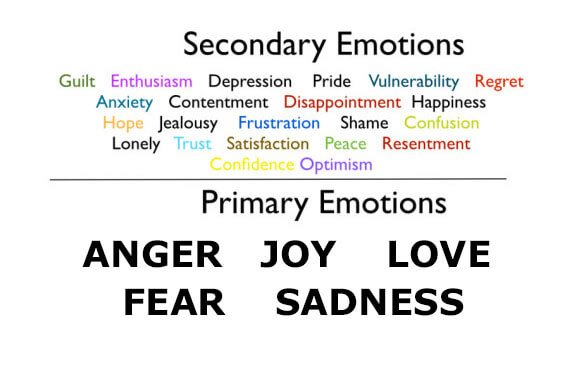
Understanding Primary and Secondary Emotions
Human beings are emotional creatures. From the moment we are born, emotions become our internal guidance system, helping us navigate the world around us. They alert us to danger, motivate us to seek connection, signal when our needs are unmet, and influence nearly every decision we make. Yet despite living with emotions every day, many people have only a limited understanding of how they work. We often speak about emotions as though they simply happen to us, without realizing that not all emotions arise in the same way or serve the same purpose.
One of the most helpful distinctions in psychology is the difference between primary and secondary emotions. Understanding this difference can transform the way we experience ourselves and relate to others. It helps explain why people sometimes react with anger when they are actually feeling hurt, withdraw when they long for connection, or criticize when what they truly feel is fear.
Primary emotions are our first, immediate emotional responses to an event. They arise naturally and automatically before we have time to analyze or interpret what has happened. These emotions are deeply rooted in our biology and have evolved over thousands of years to help us survive and adapt. Fear alerts us to danger, sadness helps us process loss, joy encourages connection and exploration, disgust protects us from contamination, surprise prepares us for unexpected events, and anger mobilizes us to respond to perceived injustice or threats.
Because primary emotions emerge directly from our experience, they are usually brief and informative. They tell us something important about our internal world. Fear may tell us that we perceive danger. Sadness may reveal that we have lost something meaningful. Guilt may remind us that our behavior has violated our values. Primary emotions are not problems to eliminate. They are messages inviting us to pay attention.
Secondary emotions, on the other hand, are emotional reactions to our primary emotions or to our interpretations of them. They develop moments later, sometimes so quickly that we hardly notice the transition. Instead of responding directly to the original situation, we begin responding to our emotional experience itself. We may feel ashamed for feeling anxious, guilty for feeling angry, frustrated because we are sad, or angry because we feel rejected. In many cases, secondary emotions become so dominant that we lose awareness of the original feeling entirely.
This distinction is especially important because therapy often involves helping people move beyond their secondary emotions in order to reconnect with the primary emotions that lie underneath. It is usually those primary emotions that reveal our unmet needs, deepest values, and opportunities for healing.
When Anger Is a Primary Emotion
Like every other emotion, anger can be a healthy and adaptive response. As a primary emotion, anger arises when we perceive that something important has been threatened, violated, or blocked. It prepares us to protect ourselves, establish boundaries, defend our loved ones, or confront injustice. From an evolutionary perspective, anger helped our ancestors survive by mobilizing energy to respond quickly to danger and competition.
Imagine someone intentionally humiliates you in front of your colleagues. Your immediate experience may be anger because your dignity has been violated. Or imagine witnessing someone bullying a vulnerable child. The anger you experience may motivate you to intervene and protect the child. In these situations, anger serves an important function. It draws attention to something that requires action.
Primary anger is usually proportionate to the situation. It has a beginning, a middle, and an end. Once the problem has been addressed or the threat has passed, the intensity of the emotion gradually decreases. Rather than creating unnecessary suffering, primary anger helps us restore balance and protect what matters.
Healthy primary anger often communicates, “Something important needs your attention.”
When Anger Becomes a Secondary Emotion
Although anger can serve a valuable purpose, it frequently operates as a secondary emotion. In these situations, anger is not the original feeling but rather a protective response that covers something more vulnerable underneath.
Consider a husband who becomes angry after his wife forgets an important anniversary. On the surface, he appears furious about the forgotten date. However, if we explore his emotional experience more deeply, we may discover that beneath the anger lies hurt, disappointment, loneliness, or the painful fear that he no longer matters to her. The anger emerged because those vulnerable emotions felt too uncomfortable to acknowledge directly.
Similarly, imagine a teenager who reacts aggressively after receiving criticism from a teacher. While the behavior appears driven by anger, the underlying experience may actually be embarrassment, shame, or fear of not being good enough. The anger functions as emotional armor, protecting the individual from experiencing more painful emotions.
This pattern is remarkably common. Anger often masks feelings such as rejection, helplessness, grief, guilt, insecurity, betrayal, disappointment, fear, or emotional pain. Because anger gives us a temporary sense of strength and control, the mind often chooses it over emotions that leave us feeling vulnerable.
Unfortunately, while secondary anger may temporarily reduce emotional discomfort, it frequently creates additional problems. Relationships become strained, communication deteriorates, and the original emotional need remains unaddressed.
Why the Mind Chooses Anger
There are several reasons why anger becomes such a common secondary emotion. One reason involves our upbringing. Many people grow up in environments where certain emotions are accepted while others are discouraged. A child who cries may hear, “Stop crying.” A child who expresses fear may be told, “Don’t be weak.” Over time, the child learns that vulnerability is unsafe. Anger, however, may feel more acceptable because it conveys strength rather than helplessness.
Cultural messages also play a role. In many societies, particularly for men, expressing sadness, fear, or emotional pain is often viewed as weakness, whereas anger is interpreted as confidence or power. As a result, people unconsciously replace vulnerable emotions with anger because it feels psychologically safer.
From a neuroscience perspective, anger also activates the body’s fight response. Rather than remaining in the uncertainty of sadness or fear, anger provides a sense of action. It creates the illusion that we are regaining control, even when no real problem-solving is taking place.
Looking Beneath the Anger
One of the most important questions we can ask ourselves during moments of anger is not, “How do I get rid of this feeling?” but rather, “What else might I be feeling?”
This question shifts our attention from the surface to the deeper emotional experience.
Instead of assuming anger is the entire story, we become curious.
- Am I actually feeling rejected?
- Am I disappointed?
- Am I afraid of losing someone I love?
- Do I feel misunderstood?
- Am I grieving?
- Has one of my important values been violated?
Curiosity transforms anger from an enemy into a guide. Rather than fighting the emotion, we begin listening to what it is trying to protect.
This approach does not mean suppressing anger or pretending it does not exist. On the contrary, it involves respecting anger enough to investigate its message. Sometimes anger itself is the primary emotion and deserves direct expression through healthy boundaries and assertive communication. Other times, anger is inviting us to discover a more vulnerable emotional reality that requires compassion rather than confrontation.
The Role of Emotional Awareness
Developing emotional awareness requires slowing down long enough to notice what is happening inside us before reacting impulsively. This is one reason mindfulness plays such an important role in emotional regulation. Mindfulness creates a pause between the emotional experience and our behavioral response. Within that pause, we gain the opportunity to ask what we are actually experiencing instead of immediately acting upon the first emotion that appears.
As we become more emotionally aware, we gradually develop greater emotional flexibility. We become less afraid of vulnerability because we recognize that emotions themselves are not dangerous. They are simply information. Fear tells us that we perceive risk. Sadness reminds us of what we value. Guilt points toward our conscience. Anger signals that something important requires attention. None of these emotions are inherently good or bad. Their usefulness depends upon whether we understand the message they are attempting to communicate.
Anger as a Compass
Throughout my work as an anger therapist in New York City, I have come to see anger not as an emotion to eliminate but as one to understand. Sometimes it functions as a healthy protector that encourages us to establish boundaries, defend our values, or confront injustice. At other times, it serves as a protective shield, guarding us from emotions that feel too painful or too vulnerable to acknowledge directly.
Learning to distinguish between these two forms of anger is one of the most valuable emotional skills we can develop. When we recognize primary anger, we can respond assertively and constructively. When we recognize secondary anger, we gain the opportunity to explore the deeper emotions and unmet needs that are asking for our attention.
Ultimately, emotional maturity is not measured by how little anger we experience but by how willing we are to understand it. When we approach anger with curiosity rather than judgment, we discover that beneath every emotional reaction lies an opportunity for greater self-awareness, deeper compassion, and healthier relationships. In this sense, anger truly becomes a compass—not because it tells us whom to blame, but because it points us toward what matters most within ourselves.
Primary Versus Secondary Emotions
Primary emotions are emotions that we feel first, as a first automatic reaction to a situation. For example, if we are threatened, we may feel fear or anger. When we experience loss, we may feel sadness. Primary emotions are unthinking, instinctive responses that we have. We will typically see these in animals also, which confirms our suspicion that they have an evolutionary basis.
Secondary emotions are emotional reactions we have to other emotions. For example, a person may feel ashamed as a result of becoming anxious or angry. In this case, anxiety would be the primary emotion while shame would be the secondary emotion.
Anger arises for a variety of reasons. Only when you have determined the trigger factors and their real cause, then will you be able to deal with it properly. When you discover the source of your anger and identify your need, you will find a way to address your anger appropriately.
Anger is one of the five 5 primary emotions (mad, sad, glad, fear, and disgust). Some people add the emotion of surprise to this list. These primary emotions are found in all human species as well as some “subhuman primate species” (apes, monkeys, etc.).
With the exception of gladness and surprise, all of the primary emotions are primitive threat detectors that alert us to the presence of threat and prepare our bodies to deal with the threat. Similar to the smoke and heat detectors that exist in your house, each emotional threat detector reacts to a different type of threat.
Our emotional threat detectors were designed to protect our ancestors from physical harm. It was designed to keep us alive and serve as a survival mechanism. Yet, today it creates a new problem. While we still may encounter survival-based threats today, most of the threats that we experience are psychological threats. These are threats to our boundaries, our dignity, our respect, our values, our sense of right and wrong, etc.
Some of the emotional responses that our ancestors developed to enable them to cope with their everyday situations can seem confusing when we experience them in our everyday situations, especially if we don’t understand their origins or why they are triggered in particular situations.
This is why it is important to realize the original purpose of anger, its reactivity, and then be able to use it constructively. The usefulness of anger comes in being able to harness, master and direct it beneficially, rather than acting on it impulsively. Your anger is a tool that you must learn to use and transform.
Mastering anger involves knowing what anger is (a primitive threat detector), knowing the message of anger (my need is blocked), and taking the time to assess the threat and need and accordingly and choose a response. Assessing the threat means you have to decide if the threat is real or is as a result of a false-positive (mistake in appraisal). If it is a genuine and relevant threat, you should use the motivation and the power of your anger to counter-attack the threat. In this case, anger serves as a primary emotion.
In other possibilities, anger can serve as a secondary emotion. In these cases, anger covers up other emotions. You are substituting your anger for other feelings such as sadness, hurt, or vulnerability or that you have misunderstood the actions of another, and what appeared to be a threat is not a threat.
For example, the critical comments of your colleague that you received at work might not mean that they are a threat or a lack of respect, but rather a difference of opinion in the best interest of the company, or they just did not know how to communicate their ideas.
It is only when you identify that underlying experience and its corresponding response that you can stop your explosions and channel your anger and redirect its focus on positivity and purpose. The constructive direction and momentum you develop will help you be more productive and emotionally balanced.
Powerful and Effective Anger Management in New York City
Through learning self-awareness, emotional regulation, and healthy communication, individuals can break the cycle of impulsive outbursts and reduce the stress, conflict, and damaged relationships that often follow. Anger management helps transform anger from a source of tension into a force for positive change, allowing a person to protect their values and needs without harming themselves or others. Learn more about spiral2grow Marriage Family Therapy, which provides unique and effective anger management in New York City.

