



Open Relationship – Balancing Adventure and Stability
Relationships are evolving.
For generations, monogamy was often treated as the default model for love, commitment, and partnership. Today, more individuals and couples are thoughtfully exploring relationship structures that better align with their values, desires, emotional needs, and understanding of intimacy. Open relationships, ethical non-monogamy, consensual non-monogamy, and polyamory are increasingly becoming part of the relationship landscape—not as rebellion against commitment, but as intentional efforts to build relationships based on honesty, freedom, authenticity, and conscious choice.

At their best, open relationships can offer profound opportunities for personal growth, emotional honesty, expanded intimacy, and greater relational freedom. At their most challenging, they can bring insecurity, jealousy, confusion, boundary violations, emotional overwhelm, and deep relational rupture. The difference is rarely in the relationship structure itself. The difference lies in how the relationship is built, communicated, and navigated.
Healthy non-monogamous relationships require tremendous emotional maturity. They demand clear agreements, deep self-awareness, honest communication, strong boundaries, and the ability to navigate difficult emotions without collapsing into blame, secrecy, or chaos. This is where open relationship counseling becomes invaluable.
Open relationship counseling provides individuals and partners with the tools, insight, and emotional support needed to build consensual non-monogamous relationships that are intentional, secure, respectful, and emotionally healthy. At its core, open relationship counseling is not simply about managing multiple connections—it is about learning how to build relationships with greater honesty, awareness, and relational integrity.
What Is Open Relationship Counseling?
Open relationship counseling is a specialized form of relationship therapy designed to help individuals and partners navigate consensual non-monogamous relationships in healthy, thoughtful, and sustainable ways.
This includes counseling for:
- open relationships
- open marriages
- ethical non-monogamy (ENM)
- consensual non-monogamy (CNM)
- polyamorous relationships
- relationship agreements involving outside partners
- couples considering opening their relationship
- individuals navigating multiple emotional attachments
Open relationship counseling helps partners clarify:
- motivations
- expectations
- boundaries
- agreements
- attachment needs
- communication styles
- conflict patterns
- emotional triggers
Most importantly, it helps people create relational structures rooted in intentionality rather than impulsivity.
Healthy openness is not simply about freedom—it is about responsibility, emotional honesty, and relational maturity.
Why People Choose Open Relationships
People choose open relationships for many reasons.
Some value sexual exploration while maintaining emotional commitment with a primary partner. Others believe love is expansive and not limited to one connection. Some seek greater authenticity in how they relate, wanting relationships that feel consciously chosen rather than socially prescribed.
People may choose consensual non-monogamy because they value:
- freedom and autonomy
- sexual honesty
- expanded intimacy
- emotional growth
- multiple meaningful connections
- authenticity in relational expression
- challenging traditional relationship assumptions
- creating agreements that fit their values rather than cultural expectations
For many, open relationships are not about avoiding commitment—they are about redefining commitment in ways that feel more honest and aligned.
When approached consciously, open relationships can foster remarkable levels of self-awareness, communication, and emotional maturity.
The Challenges of Open Relationships
While open relationships can be deeply fulfilling, they also introduce complexities that require careful navigation. Opening a relationship often magnifies emotional patterns that already exist. Unresolved insecurity becomes more visible. Attachment wounds become activated. Communication weaknesses become exposed. Boundaries become critically important.
Common challenges include:
- jealousy
- insecurity
- fear of abandonment
- comparison with other partners
- broken agreements
- secrecy
- emotional imbalance
- mismatched expectations
- time management strain
- unclear boundaries
- attachment conflict
- navigating multiple emotional bonds
These challenges are not signs that non-monogamy “doesn’t work.” They are invitations for deeper growth.
Understanding Jealousy in Open Relationships
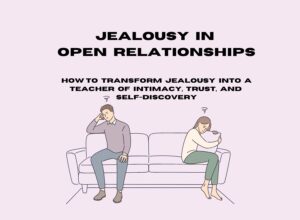
Jealousy is one of the most misunderstood emotions in consensual non-monogamy. Many people assume that jealousy means openness is failing. Not necessarily. Jealousy is often a signal—not unlike anger—that points toward something important:
insecurity
fear of loss
unmet needs
comparison
lack of reassurance
attachment anxiety
boundary confusion
old emotional wounds
Boundaries and Healthy Agreements
Freedom without boundaries creates instability. Healthy non-monogamous relationships require clear agreements.
These may include agreements around:
- sexual health and safety
- emotional involvement with others
- communication transparency
- time management
- privacy versus secrecy
- disclosure expectations
- overnight stays
- dating friends or shared social circles
- emotional prioritization
- relationship hierarchy or non-hierarchy
Agreements must be:
- explicit
- mutual
- revisited regularly
- grounded in honesty
- flexible enough to evolve
- clear enough to reduce ambiguity
Unspoken assumptions are dangerous in any relationship—but especially in open dynamics. Clarity creates safety.
Communication Is Everything
Open relationships demand extraordinary communication.
Partners must learn how to discuss:
- desire
- insecurity
- boundaries
- attraction to others
- jealousy
- emotional needs
- fears
- agreements
- disappointments
- repair after mistakes
This requires communication that is:
- honest
- emotionally mature
- compassionate
- clear
- direct
- accountable
Avoidance creates secrecy. Secrecy creates rupture.
Honest communication builds trust.
The strongest open relationships are often those where difficult conversations become a normal and respected part of relational life.
Attachment, Security, and Emotional Safety
No matter how open a relationship becomes, attachment needs still matter.
People still need:
- reassurance
- emotional safety
- consistency
- reliability
- belonging
- care
- emotional responsiveness
Without secure attachment, openness can feel destabilizing.
Attachment insecurity may show up as:
- clinginess
- emotional withdrawal
- controlling behavior
- excessive reassurance seeking
- fear-based boundaries
- panic when a partner connects elsewhere
Open relationship counseling helps partners understand attachment patterns and build emotional security alongside relational freedom.
Freedom and security do not have to be opposed.
Healthy relationships cultivate both.
Opening an Existing Relationship
Opening a previously monogamous relationship is often one of the most emotionally complex transitions a couple can face.
It raises difficult questions:
Why open now?
What needs are being expressed?
Are both partners genuinely willing?
Is there hidden pressure?
What fears need attention?
What agreements create safety?
If a relationship already struggles with trust, communication, or unresolved resentment, opening it may magnify those fractures.
Opening works best when the foundation includes:
- trust
- strong communication
- emotional honesty
- mutual willingness
- clear boundaries
- secure attachment
Opening a relationship should be a conscious relational choice—not an escape from unresolved problems.
Polyamory and Multiple Attachments
Polyamory introduces another layer of emotional complexity because multiple meaningful emotional bonds may develop.
This raises questions about:
- attachment hierarchy
- time and emotional energy
- competing needs
- communication between partners
- jealousy and comparison
- fairness
- inclusion and belonging
- emotional responsibility
Polyamory asks people to expand their relational capacities—emotionally, practically, and psychologically.
Done consciously, it can create rich relational ecosystems. Done unconsciously, it can create confusion and pain. This is why awareness and emotional maturity become essential.
Repair After Rupture
Even healthy open relationships experience rupture.
Agreements may be broken. Boundaries may be crossed. Trust may be damaged. Emotional wounds may emerge.
Repair requires:
- honesty
- accountability
- transparency
- empathy
- listening deeply
- clarifying unmet needs
- rebuilding trust through consistent action
Repair is what transforms mistakes into growth.
Without repair, resentment grows.
With repair, relationships deepen.
Betrayal and Infidelity in Open Relationships
One of the greatest misconceptions about open relationships is the belief that because a relationship allows outside connections, betrayal and infidelity are no longer possible.
That is simply not true.
Infidelity is not defined solely by sexual contact with another person, it is defined by the breaking of trust, violation of agreed-upon boundaries, secrecy, dishonesty, and emotional betrayal.
Even in consensual non-monogamous relationships, trust remains sacred.
A partner may feel deeply betrayed when:
- agreed-upon boundaries are violated
- important information is intentionally withheld
- secrecy replaces transparency
- emotional intimacy with another partner exceeds what was mutually agreed upon
- safer-sex agreements are broken
- a partner acts impulsively without regard for shared commitments
- deception, manipulation, or gaslighting enters the relationship
In many cases, the wound is not the outside relationship itself—it is the breach of trust surrounding it.
The emotional impact can be profound:
- heartbreak
- anger
- shame
- insecurity
- jealousy
- fear of abandonment
- deep questioning of the relationship’s foundation
For some, betrayal in an open relationship can feel especially confusing because they may struggle to understand why hurt is so intense in a structure that allows openness. Yet the answer is simple: openness does not eliminate the human need for honesty, safety, respect, and relational integrity.
Repairing betrayal in consensual non-monogamy requires the same core principles as in any relationship:
- radical honesty
- accountability without defensiveness
- genuine empathy for the injured partner’s pain
- transparency moving forward
- re-examining agreements and boundaries
- rebuilding trust through consistent action over time
It also requires deeper reflection:
What led to the breach?
Was it impulsivity, avoidance, unmet needs, attachment insecurity, resentment, poor communication, or unclear agreements?
What relational dynamics made betrayal more likely?
What must change for trust to be rebuilt?
Betrayal does not automatically mean the relationship must end—but it does require truth, courage, humility, and meaningful repair.
When couples confront rupture honestly, betrayal can become a turning point—an opportunity to create stronger agreements, deeper emotional awareness, and a relationship built on greater integrity than before.
In open relationships, freedom and commitment are not opposites. True freedom thrives only when supported by honesty, responsibility, and trust.
Working with Moshe Ratson, LMFT, MBA
Navigating open relationships requires more than broad-mindedness—it requires deep relational skill.
Moshe Ratson brings a thoughtful, sophisticated, and emotionally grounded approach to open relationship counseling. His work integrates Emotionally Focused Therapy (EFT), Internal Family Systems (IFS), and the Gottman Method to help individuals and couples build secure, conscious, and emotionally healthy non-monogamous relationships.
He helps clients:
- clarify relationship agreements
- navigate jealousy and insecurity
- strengthen communication
- build healthy boundaries
- understand attachment dynamics
- repair ruptures
- create emotionally sustainable relational structures
His approach is nonjudgmental, deeply relational, psychologically informed, and practical.
Rather than imposing rigid models, he helps clients create relationship structures aligned with their values, needs, and emotional truth.
Creating Conscious, Healthy Non-Monogamous Relationships
Open relationships can be deeply fulfilling—but only when they are built consciously.
Healthy non-monogamy requires:
- honesty
- emotional maturity
- self-awareness
- accountability
- communication
- boundaries
- repair
- compassion
- relational integrity
At its best, open relationship counseling helps people move beyond fear, secrecy, and confusion into relationships built on authenticity, trust, freedom, and deep emotional connection.
The goal is not simply more freedom. The goal is healthier love. Love that is built on truth, awareness, and conscious choice.

Navigating Non-Monogamous Relationship
Despite having clear guidelines, navigating the complexities of an open relationship can be difficult. The newfound freedom often introduces unexpected emotions, such as jealousy, communication breakdowns, resentment, or the fear that one partner might develop romantic feelings for someone else. This is especially true when the excitement of a new sexual encounter contrasts sharply with the comfortable familiarity of long-term intimacy.
Balancing adventure and stability in an open relationship requires intentional effort, clear communication, and mutual understanding. The allure of an open relationship often stems from the desire to explore new experiences and inject excitement into a partnership. However, maintaining stability within the primary relationship is crucial to ensuring that both partners feel secure, valued, and emotionally connected.
Key Strategies for Balancing Adventure and Stability
Establish Clear Boundaries:
Setting agreed-upon rules helps create a framework within which both partners can explore without undermining the stability of the relationship. These boundaries might include guidelines around sexual safety, emotional involvement, or how much to share.
Prioritize Communication
Regular, open conversations about feelings, expectations, and experiences are essential. Both partners should feel comfortable expressing concerns or discussing changes in how they feel as the relationship evolves. This ongoing dialogue can prevent misunderstandings or resentment from building.
Maintain Emotional Connection
While adventure adds excitement, the core emotional connection should remain the foundation. Engaging in activities that nurture intimacy, such as regular date nights or quality time together, reinforces the bond between partners and keeps the relationship solid.
Revisit and Adjust Agreements
The dynamics of an open relationship may change over time. What works at one stage might need adjustment later. Regularly revisiting the agreements and checking in with each other ensures that both partners continue to feel safe and satisfied.
Recognize Potential Risks
Alongside adventure comes the risk of jealousy, insecurity, or emotional entanglement with outside partners. Acknowledging these risks upfront and having strategies to address them can help mitigate potential disruptions to the primary relationship.
Stay Flexible but Committed
Flexibility allows for adventure, but commitment to the primary relationship provides the stability needed to manage any challenges that arise. Both partners must agree that their connection comes first, ensuring that external experiences don’t threaten their bond.
By carefully managing the balance between exploration and security, couples can enjoy the excitement of an open relationship while maintaining the emotional stability that sustains their long-term connection.

