



A Flame Like Anger
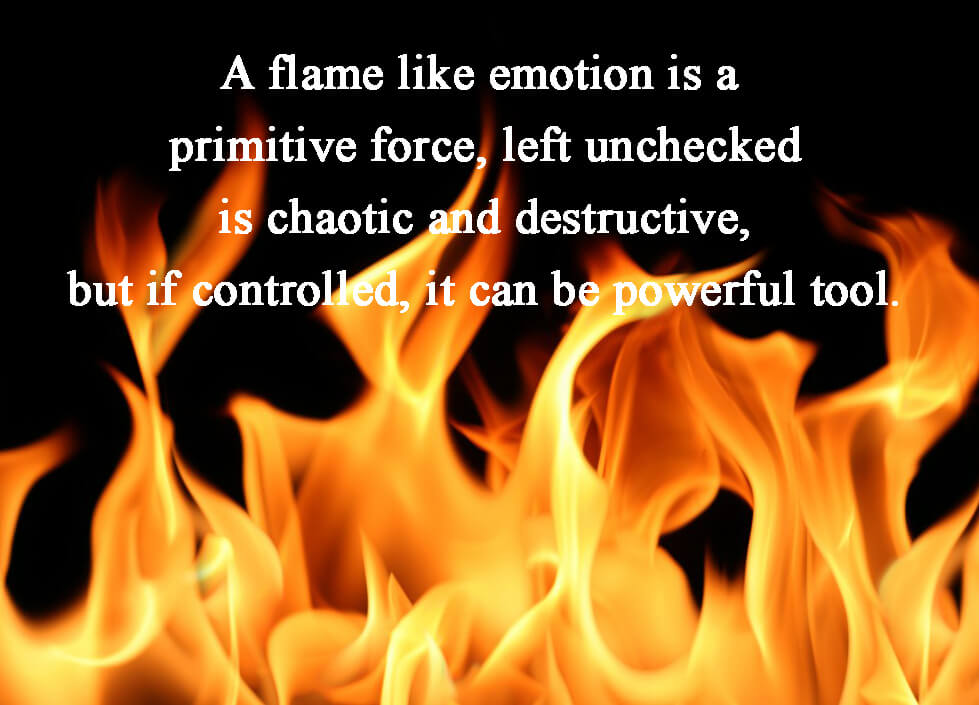
A flame-like emotion is a primitive force, left unchecked is chaotic and destructive, but if controlled, it can be a powerful tool. Like the lamp that controls the flame, our brain can control our emotions, and we as humans can learn to manage our emotions in a constructive manner.
In the past (as a child), your anger was a source of strength and at times, gave you courage while it protected you. It serves you as a “survival mechanism.” But, now, as an adult, if you realize that you are not in a survival situation, you can build a better mechanism to protect yourself and use the emotions as a signal and indicator to your status.
When you pay attention to this signal (the emotion) try to stay with it and not to react to it. Then, you can slowly figure out what this signal means and what your need is. Once you realize your need, think and find a constructive way to express your need in a respectful, assertive manner. It is important to note that expressing your needs does not necessary leads to fulfilling your needs. In this regard, one has to know what is within his power and what is beyond his power. All one can do is to do his best (within his power) to get what he needs, yet accept what is beyond his power and accept it.
Originated in StarTrek and Revised by Moshe Ratson
Anger as Fire: From Primitive Force to Conscious Power
Anger is one of our most primitive and powerful emotions. It is ancient—wired deeply into the nervous system long before reason, reflection, or philosophy emerged. At its core, anger is not bad; it is energy. It is life-force. It is the psyche’s way of saying: something matters here. A boundary has been crossed. A wound has been touched. An injustice has been perceived. A need has gone unmet. Something within you is calling for attention.
In childhood, anger often served an essential purpose. For many, it was a shield—a survival mechanism. It gave strength when feeling helpless, courage when feeling afraid, and a sense of power when feeling small or vulnerable. In moments of emotional danger, anger protected the fragile self. It helped you endure what otherwise may have felt unbearable.
But what once protected us can later imprison us.
As adults, many continue to react as though they are still in survival mode—fighting old battles in new relationships, seeing threat where there is discomfort, responding to disappointment as if it were danger. The body remembers what the mind has forgotten. The nervous system can become conditioned to interpret frustration, rejection, criticism, or unmet expectations as existential threats. In that state, anger erupts not because the present moment is truly dangerous, but because an old wound has been awakened.
This is where maturity begins: the ability to distinguish between being triggered and being threatened.
That distinction changes everything.
The disciplined mind learns to hold emotion without immediately obeying it. Instead of becoming anger, you learn to witness anger. Instead of reacting impulsively, you become curious. You pause. You breathe. You feel. You observe.
You ask:
- What is this anger trying to tell me?
- What pain lies underneath it?
- What fear, hurt, shame, disappointment, or longing is hidden beneath the heat?
- What need in me is asking to be seen?
Often, beneath anger lies something softer: hurt, grief, fear, loneliness, helplessness, or the longing to matter. Anger is frequently the armor around vulnerability. When you understand what it protects, anger becomes less of an enemy and more of a messenger.
And messengers are meant to be listened to—not blindly followed.
Once you understand the signal, wisdom asks the next question: What is the most constructive response?
This is where emotion becomes virtue.
You can transform anger into assertiveness instead of aggression.
Into courage instead of intimidation.
Into clarity instead of chaos.
Into boundary-setting instead of punishment.
Into action guided by values rather than reaction driven by wounds.
Psychology teaches us emotional regulation. Philosophy teaches us inner freedom.
The ancient Epictetus taught that human suffering often comes not from events themselves, but from our judgments about them. We do not control everything that happens to us—but we can cultivate mastery over how we respond. Likewise, Buddhist psychology teaches that grasping, aversion, and unconscious reaction create suffering, while mindful awareness creates liberation. Modern neuroscience echoes the same truth: when awareness strengthens, impulsivity weakens.
Between stimulus and response there is a sacred space—and in that space lives freedom.
Yet wisdom also requires humility: expressing your needs respectfully does not guarantee they will be fulfilled. You may communicate clearly, set healthy boundaries, ask honestly, and still not receive what you hoped for. This is one of life’s painful truths.
But here philosophy becomes a source of peace.
Know what is within your power—and what is beyond it.
Within your power:
- Your integrity
- Your effort
- Your courage
- Your honesty
- Your boundaries
- Your willingness to grow
- Your response
Beyond your power:
- Other people’s choices
- Other people’s maturity
- Other people’s love
- Timing
- Outcomes
- Life’s uncertainty
Your task is not to control life. Your task is to meet life with wisdom.
Do your best to honor your needs with clarity, dignity, and strength. Speak truthfully. Act courageously. Protect what matters. But release attachment to what you cannot command. Acceptance is not surrender—it is emotional maturity. It is the understanding that peace does not come from controlling the world, but from mastering your relationship to it.
In this way, anger becomes not a destructive flame—but a guiding light. A compass.
A force that reveals what matters, points toward truth, and calls you to become stronger, wiser, and more compassionate.
The goal is not to extinguish the fire within you. The goal is to learn how to carry it well.
If you would like to attend anger management classes or anger counseling, or overcome anger and aggression.

